


Products
Quick Links
About US
Support
We Are:


Copyright © 2025 Xuzhou BOB-LIFT Construction Machinery Co., Ltd.


Views: 0 Author: Site Editor Publish Time: 2025-12-01 Origin: Site
Act One: The Margin of Safety Behind 8 Tons
When we claim an "8-ton" rated load, this is just a starting point. During the test, engineers will conduct a "static load test" - extending the crane to the most challenging working conditions, and then slowly applying a load far exceeding 8 tons (usually 1.25 to 1.5 times, that is, 10 to 12 tons) and maintaining it for tens of minutes.
Test purpose: To verify the structural integrity, we observe whether there are any minor permanent deformations or cracks in core components such as the boom and outriggers. BOB-LIFT's answer is: Under huge loads, its structure remains as stable as a mountain, and it fully returns to its original state after unloading. This proves that its materials and welding process have sufficient "safety margin".
User value: This means that in your daily 8-ton hoisting operation, the crane is by no means struggling on the "edge of limit", but rather operates with ease, providing a solid buffer zone for unforeseen emergencies such as load swaying and wind force impact.
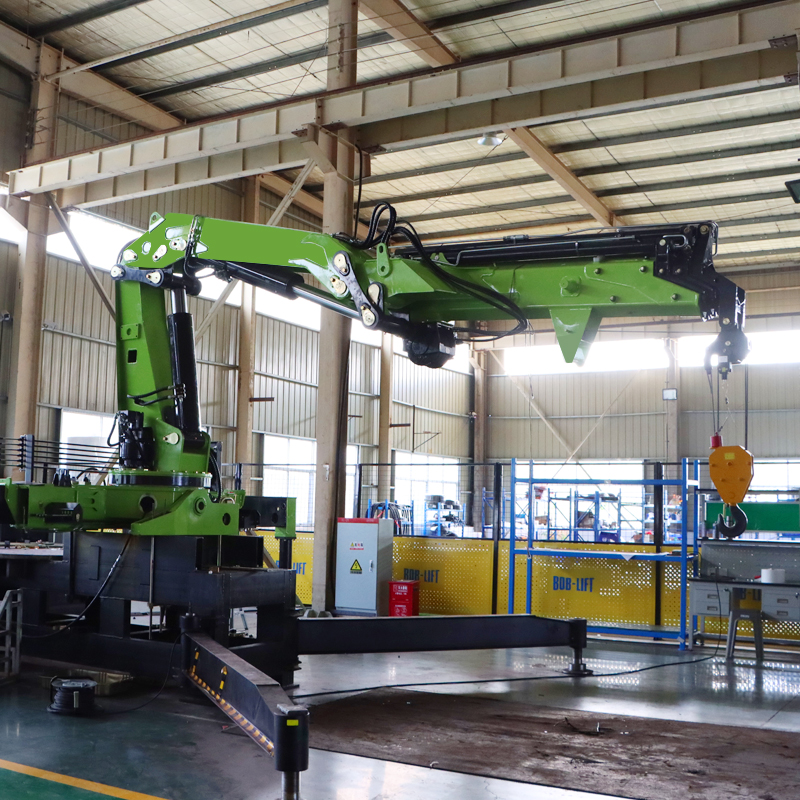
Act Two: The Art of Micro-movement and Manipulation
Strength is the foundation, while precision is the soul. Knuckle boom cranes often operate in confined Spaces. A slight deviation in lifting can lead to serious consequences.
Test scenario: We have set up the subjects of "Obstacle Crossing" and "Precise Landing Point", requiring the operator to thread the heavy object around various obstacles like threading a needle, and finally place it stably within the extremely small target area.
Technical core: What lies behind this is the precise calibration of the hydraulic system. The high-performance hydraulic system equipped in BOB-LIFT enables precise control of flow. Whether it is the lifting and lowering, extension and retraction or rotation of the boom, the movements are as smooth and steady as "continuous drizzle", effectively avoiding the violent shaking of the heavy object and greatly improving the operation efficiency and safety.
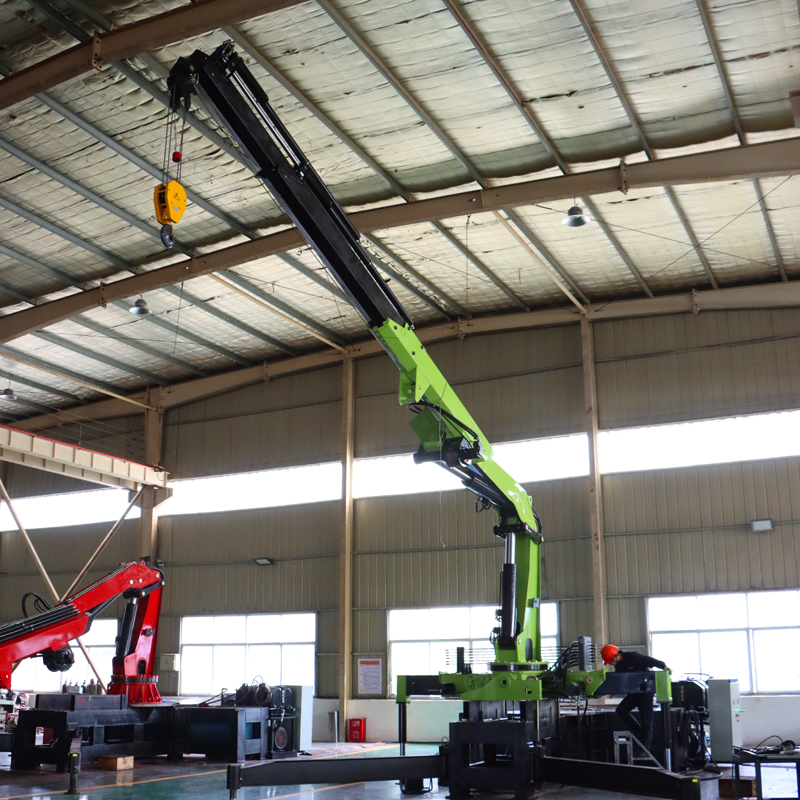
Act Three: The Battle between Outriggers and Anti-Overturning
The most dangerous enemy of cranes is not heavy objects but "overturning". The "Stability limit Test" of BOB-LIFT is precisely competing with this.
Test method: On an uneven test site, we extend the boom to the maximum extent and Angle, gradually increasing the load until the critical state is reached. Sensors installed at various parts of the vehicle body monitor in real time the forces on the four outriggers and the tilt Angle of the vehicle body.
Intelligent Protection: The test not only verified the compressive resistance of the high-strength outriggers and frame, but also calibrated the sensitivity of its torque limiting system. This system is like an experienced safety officer, capable of real-time calculation of the weight, arm length and Angle of the lifted object. Once there is a risk of overturning, it will immediately issue an alarm and restrict dangerous actions, building the last line of defense for the operator at the intelligent level.
The BOB-LIFT 8-ton knuckle boom crane shows us not a cold steel body, but an organism that integrates strength, precision and stable intelligence. Every piece of data from the test is injecting confidence into each of your hoisting operations.
